Transforming TKTS
“A 40-year-old ticket booth transformed into a live, API-driven sales platform; delivering real-time pricing integration across six West End systems.”
Problem
As Digital Lead for the Society of London Theatre (SOLT), I was responsible for guiding the digital transformation of TKTS — the iconic Leicester Square ticket booth that has been selling on-the-day discounted London theatre tickets since 1981.
Originally known as the half-price ticket booth, TKTS rebranded in 2001 to align with similar outlets worldwide. Despite its status as a cornerstone of the West End, TKTS had never sold tickets online. Its long-standing setup relied on a stand-alone ticketing system, allowing only same-day, in-person transactions.
SOLT wanted to bring TKTS into the modern era with a hybrid ticketing platform that would enable both in-person and online sales, powered by real-time API connections to theatre box offices. The aim was to provide customers with consistent pricing and availability whether purchasing at the booth or online.
However, analysis revealed a significant challenge. The West End’s ticketing ecosystem was fragmented across six different systems, each with its own architecture. Adapting the existing booth software would require costly bespoke middleware, be difficult to maintain, and ultimately compromise the user experience.
A new, unified approach was needed to modernise TKTS and ensure it could continue to serve both Londoners and tourists effectively.
Solution
Gap Analysis and Strategic Direction
The project began with a comprehensive gap analysis of the West End’s complex ticketing environment. The goal was to define how TKTS could sell online and in person using live integrations, while maintaining full pricing control and operational efficiency.
Initially, we explored whether the existing booth ticketing system could be expanded to support online sales. This would have offered continuity for the team, minimal workflow disruption, and reduced training needs. However, once the cost and maintenance implications of building the necessary middleware were fully understood, it became clear that this approach was not viable.
With SOLT’s support, I led the decision to re-tender for a new ticketing partner capable of unifying all ticketing operations across TKTS and SOLT’s promotional campaigns. This allowed us to take a long-term view and align technical capability with strategic goals.
Tendering for a New Ticketing System
The new tender brief emphasised flexibility, scalability, and real-time connectivity. Key requirements included:
Enabling API-driven ticket sales rather than static allocations
Integrating with all current and future West End venues
Handling high-volume promotions such as Kids Week and New Year Sale
Supporting both in-person and online ticketing
Displaying percentage-based discounts transparently
Providing robust customer service functionality
Establishing a long-term partnership to deliver future innovation
To attract the right expertise, we opened the tender to ticketing agents and technology providers with established West End experience rather than limiting it to traditional system vendors.
Selecting the Supplier
After a detailed evaluation process, See Tickets was selected as the new partner. Their proven experience with SOLT’s large-scale promotions and pre-existing integrations with four of the six ticketing systems made them an ideal fit.
Together, we conducted a joint deep-dive gap analysis to identify key technical requirements and define the roadmap for the new TKTS platform.
Essential development areas included:
Managing both Open (shared) and Exclusive (TKTS-only) inventory
Selling both on-the-day and advance tickets through one platform
Presenting real-time discount pricing
Integrating with Adyen EPOS for in-person sales
Supporting Theatre Tokens for payment and redemption
Increasing pricing data import frequency to keep pricing as close to real time as possible
See Tickets subsequently rebuilt their import architecture to handle concurrent data synchronisation across multiple venue systems – a major step towards achieving live pricing accuracy.
Solving the Discount Display Challenge
During implementation, a crucial issue emerged. TKTS’s brand promise relies on clearly showing percentage discounts, yet the API data being returned from venue systems did not include the original “face value” ticket price.
This made it impossible to display savings accurately. For instance, instead of:
Face Value = £50, Ticket Cost = £25 (50% discount)
the API returned only:
Face Value = £22.50, Ticket Cost = £25.00
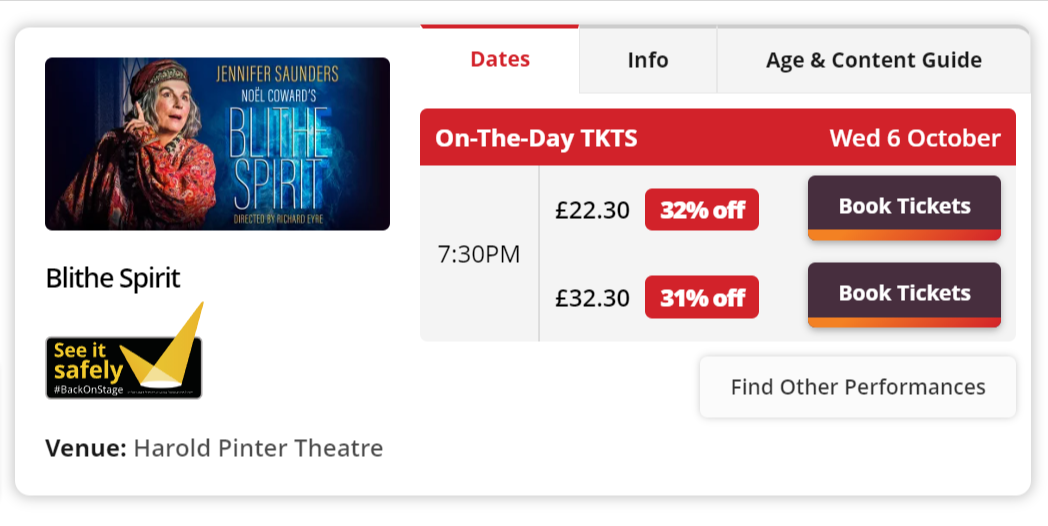
We created a two-price comparison model that imported both discounted and full-price values. By comparing the two, the system could calculate and display the correct percentage saving dynamically.
This innovation preserved TKTS’s core identity and gave customers the clear, transparent pricing they expected.
User Experience and Search Redesign
To ensure TKTS’s digital experience matched its in-person charm, we redesigned the search and discovery journey from the ground up.
Previously, searches on the Official London Theatre site were limited to shows active within the selected date range. Using Google Analytics and Hotjar, we tracked user behaviour to understand how visitors searched for tickets. The findings revealed a clear hierarchy:
Discounts > Date > Time > Show.
We used this insight to rebuild the search interface so customers could find the best deals first, while still having the option to browse alphabetically when comparing shows.
To improve clarity, we created custom empty-state messages explaining why no results might appear, for example, if a show was not performing on a selected date or the ticketing API temporarily failed to return data.
To streamline content updates, we repurposed each show’s SEO meta description as its synopsis. This reduced duplication and kept the content team’s workflow efficient.

Inventory Logic and Pricing Display
Because “Open” and “Exclusive” ticket inventory could not coexist on the same seating plan, we implemented logic to prioritise TKTS-exclusive availability. This ensured customers always saw the best possible offer without confusion.
Research showed that users were driven primarily by value, so our pricing presentation followed this principle:
Where discounts were available, only the discounted price and percentage saving were shown.
For full-price tickets, we displayed price ranges to maintain a focus on value while supporting a consistent layout.
This strategy both highlighted the TKTS brand’s strength in discounts and encouraged theatres to offer more competitive pricing.

Outcome
The new TKTS platform launched successfully as part of the Official London Theatre website, marking the first time in its history that the brand offered real-time online theatre ticket sales.
As Digital Lead for the Society of London Theatre, I oversaw the project from inception through delivery – aligning stakeholder needs, defining technical strategy, managing supplier collaboration, and ensuring a smooth integration between in-person and online sales.
The result is a unified ticketing platform that combines API-driven data, real-time pricing, and a seamless user experience. TKTS now stands as a model for how traditional box office systems can evolve to meet modern audience expectations.
Following the reopening of theatres post-lockdown, TKTS played a key role in SOLT’s recovery strategy, helping the industry reconnect with audiences and reignite London’s passion for live theatre.